
The Eighth Amendment bar on cruel and unusual punishment has a number of applications to prison litigation. (Note that this section of law applies to convicted prisoners, whereas analogous claims from pretrial detainees held in a jail or other setting stem from the Fourteenth Amendment.) Some of the most common types of potentially viable claims under the Eighth Amendment are:
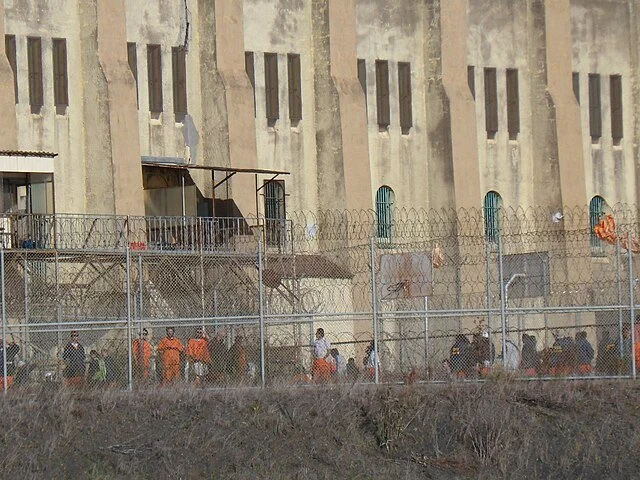
San Quentin prison. Photo by user Zboralski from Wikimedia Commons under a Creative Commons license.
Exposure to Dangerous Physical or Environmental Conditions. Knowingly exposing an inmate to a dangerous physical environment, such as a facility full of asbestos, may constitute deliberate indifference. Wallis v. Baldwin, 70 F.3d 1074, 1075 (9th Cir. 1995). Forcing an inmate to work with equipment that is known to be defective and dangerous, and thereby causing them to become injured, can also satisfy this standard. Morgan v. Morgensen, 465 F.3d 1041 (9th Cir. 2006).
Denial of Exercise and Recreation. Prisoners have a clearly established right to “outdoor exercise or otherwise meaningful opportunities for recreation” and the denial of that right for extended periods of time can constitute an Eighth Amendment violation. Cardenas-Ornelas v. Johnson, 24-6755.
Denial of Medical Care. The total denial of care for serious medical conditions can constitute deliberate indifference. Williams v. Andreasen, No. CIVS042515FCDEFBP, 2008 WL 508073, at *13 (E.D. Cal. Feb. 22, 2008), report and recommendation adopted, No. CIVS042515FCDEFBP, 2008 WL 895684 (E.D. Cal. Mar. 31, 2008). Note that while actually providing medical care to an inmate in a deliberately indifferent fashion can theoretically be the basis for liability, such claims are quite challenging in practice absent really egregious facts.
Failure to Protect from Assault by Other Inmates. A case in which prison officials failed to protect an inmate from assault by fellow inmates, Farmer v. Brennan, 511 U.S. 825 (1994) is often cited as source of the “deliberate indifference” standard itself. Such a failure can occur through not taking action, as well as acting in a way that knowingly exposes an inmate to harm. Clem v. Lomeli, 566 F.3d 1177, 1181-1182 (9th Cir. 2009).
Use of Force in a “Malicious” and “Sadistic” Manner. Whereas claims of “excessive force” are typically brought under the Fourth Amendment by plaintiffs who are not in custody, this type of claim is asserted under the Eighth Amendment in the prison context and requires a showing that the force used was employed “maliciously and sadistically to cause harm” rather than in “a good-faith effort to maintain or restore discipline.” Hudson v. McMIllan, 503 U.S. 1, 6-7 (1992). The requirement that force be used “sadistically” does not require a showing that the officer took pleasure from inflicting pain. Hoard v. Hartman, 904 F.3d 780, 782 (9th Cir. 2018). Nor does it necessarily require a serious injury, though the nature of any injury is relevant to the inquiry: “When prison officials maliciously and sadistically use force to cause harm, contemporary standards of decency always are violated. This is true whether or not significant injury is evident." Bearchild v. Cobban, 947 F.3d 1130, 1141 (9th Cir. 2020) (quotation omitted). The "core judicial inquiry" focuses on whether the forced used was "nontrivial and was applied maliciously and sadistically to cause harm," rather than on the "extent of the injury." Wilkins v. Gaddy, 559 U.S. 34, 39 (2010).
Excessive or Improper Segregation/Separation. The law on conditions in segregation is challenging. There are some relatively good cases on degrading or unhealthful conditions in segregation (see, e.g., Keenan v. Hall, 83 F.3d 1083, 1090 (9th Cir. 1996)), but merely being restrictive is not, in itself, an Eighth Amendment violation. Toussaint v. McCarthy, 801 F.2d 1080, 1106-1107 (9th Cir. 1986).
Claims of Deliberate Indifference in Transportation of an Inmate are challenging to make successfully, as there is SCOTUS authority that a mere car accident is not evidence of deliberate indifference. Parratt v. Taylor, 451 U.S. 527, 544 (1981). There needs to be evidence of additional, specific factors suggesting a subjective decision by correctional officials to ignore apparent risks to the person being transported, such as a refusal to provide a seatbelt to an individual who requests one. See James v. Pelayo, No. 1:25-cv-01399-JLT-SAB (PC) (E.D.Cal. March 5, 2026) 2026 U.S. Dist. LEXIS 45723.
At least in theory, equivalent claims could also exist under Article 1 Section 17 of the California Constitution, which also bars cruel and unusual punishment, but there is no private right of action for damages arising out of a violation of the cruel or unusual punishment clause of the California Constitution. See Giraldo v. Cal. Dep't of Corr. & Rehab., 168 Cal. App. 4th 231, 253 (2008). In other words, even if there is a violation of the law, an individual typically cannot bring an action to enforce the law. The types of claims that would be alleged as Eighth Amendment violations under 42 U.S.C. § 1983 could perhaps be alleged via the statutory “wrapper” of California’s Bane Act. That is so since objective deliberate indifference — which is a less challenging standard than the subjective form of deliberate indifference that must be shown under the Eighth Amendment — will satisfy the specific intent component of a Bane Act cause of action. See Est. of Hernandez v. San Diego County, 24-cv-00032-DMS-DEB at * 25-26 (S.D.Cal. Sept. 30, 2024) (“the Court has determined that the Complaint alleges a claim under the objective deliberate indifference standard. [Citation.] Thus, the Complaint states a Bane Act claim against Defendants”).
The clearest examples of this approach in the caselaw appear to be in the area of denial of medical care. See M.H. County of Alameda, 90 F.Supp.3d 889, 897 (N.D.Cal. April 17, 2013); Dixon v. Partida, 22-cv-04461-AMO (N.D.Cal. Nov. 10, 2025) 2025 U.S. Dist. LEXIS 221762 at * 31-32. It is unclear whether the use of a Bane Act “wrapper” would allow litigation of something like a denial-of-exercise claim purely under California law.