A public employee’s claim to have experienced retaliation on the basis of expression that is protected under the First Amendment is analyzed under Pickering v. Bd. of Ed. of Twp. High Sch. Dist. 205, 391 U.S. 563, 568 (1968). Under Pickering, if the plaintiff is able to make a prima facie showing that adverse action was taken on the basis of protected speech, the defendant must then show either “(1) that its legitimate administrative interests in promoting an efficient workplace and avoiding workplace disruption outweigh the plaintiff’s First Amendment interests; or (2) alternatively, the government would have taken the same actions absent plaintiff’s expressive conduct.”
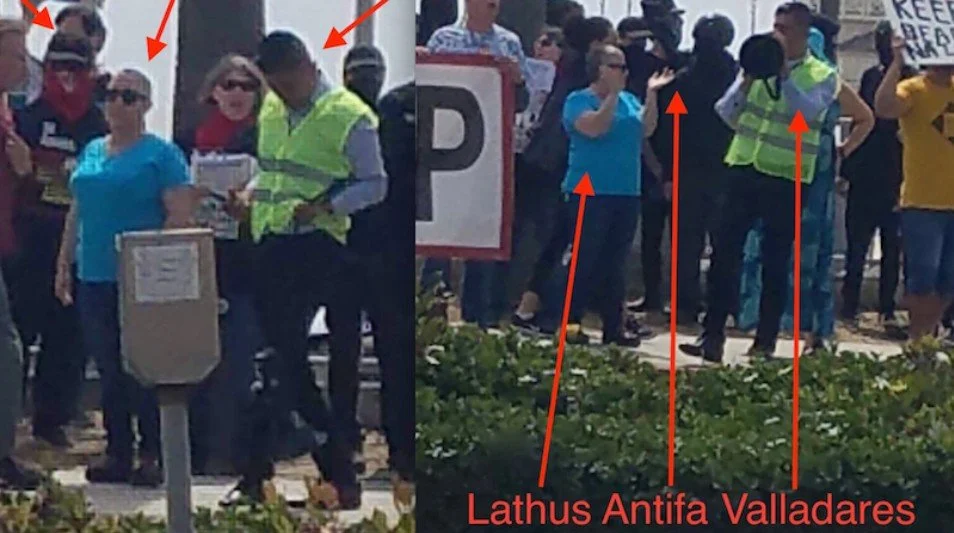
Images shared on social media that gave rise to the dispute in Lathus v. City of Huntington Beach, 56 F.4th 1238 (9th Cir. 2023).
However, when the nature of a public position is such that “party affiliation is an appropriate requirement for the effective performance of the public office involved” employment may be conditioned on such party affiliation. Branti v. Finkel, 445 U.S. 507, 523 (1980). As the Ninth Circuit put it, “the First Amendment does not succor casualties of the regular functioning of the political process.” Blair v. Bethel School District, 608 F.3d 540, 545 (9th Cir. 2010). There is a continuum of public positions from the highly political — i.e., the appointed staff of an elected leader — to the essentially apolitical, such as an administrative clerk, and the analysis of whether this exception applies will depend on where on that continuum a particular position is. In Branti, assistant public defenders could not be fired for being members of the Republican party even though their new boss, a Democrat, was an elected official. 445 U.S. at 519-520. On the other hand, when an assistant prosecutor announced a candidacy for the office of the prosecutor and was fired by the prosecutor already occupying that position, the resulting First Amendment claim failed because the assistant prosecutor position was viewed as “policymaking” and the firing was simply the give-and-take of the political system. Fazio v. City & County of San Francisco, 125 F.3d 1328, 1334 (9th Cir. 1997).
If the plaintiff is not an employee but rather a volunteer for a public agency, the retaliation claim is assessed under cases like Blair and Lathus v. City of Huntington Beach, 56 F.4th 1238 (9th Cir. 2023), which hold that an appointed volunteer may be dismissed for statements that might otherwise be protected by the First Amendment when “commonality of political purpose” is an appropriate requirement for the volunteer’s services. Lathus, 56 F.4th at 1241. In Lathus, a volunteer member of an advisory board for a city was photographed at a rally with supposed “antifa” members, and was then fired from that position on that basis, and her dismissal was upheld against a First Amendment challenge.
A public employee’s claim that their right to religious freedom has been impaired by their employer by singling out the religion in some fashion will probably be evaluated under Kennedy v. Bremerton Sch. Dist., 597 U.S. 507 (2022). Under that standard, if a plaintiff shows that a challenged policy burdens his sincere religious practice and is not neutral or generally applicable, the burden shifts to the government to “satisfy ‘strict scrutiny’ by demonstrating its course was justified by a compelling state interest and was narrowly tailored in pursuit of that interest.” 597 U.S. at 525. That test looks to the strength of the government’s interest. Religious expression can thus be “doubly protected” under both the Free Exercise and Free Speech Clauses. Id. at 543. The courts have seen a lot of litigation of these issues in connection with vaccination requirements imposed by public employers and the ostensible religious objections to such requirements. See, e.g., Bacon v. Woodward, 104 F.4th 744 (9th Cir. 2024). However, many vaccination requirements are facially neutral and generally applicable and thus do not trigger the Kennedy standard but rather a more deferential type of review. See Doe v. San Diego Unified Sch. Dist., 19 F.4th 1173, 1177 (9th Cir. 2021).
To consult about a potential civil rights case, call today.