
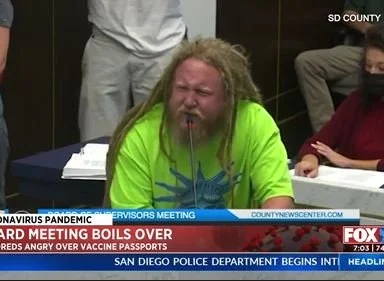
What is going on with the stories of folks being arrested for speaking up in public meetings to oppose data centers? Don’t these people have First Amendment protections? And how can it be that in some meetings, people seem to be able to have volcanic meltdowns at the podium or are very playful and subversive in the style of their comments and yet are allowed to keep speaking, while other people get shut down or arrested for doing much less?
There is a whole range of expression and conduct that can occur in public meetings, and there are indeed First Amendment protections that apply in this sphere, but there are nuances to this area of the law because of the way speech and conduct blur together. The speech itself is generally subject to First Amendment protections, but regulation of many aspects of the “manner” in which a person delivers their comments can erect some fairly strong limitations around public comment periods without necessarily violating the law.
Let’s start with the basics: public meetings of government agencies are described as limited public forums. They are different from a park or a street, where any random person can stand around speaking to the public, in that there are usually designated periods for the public to speak, but the agency usually also has other business to conduct, so these meetings are not only a stage for members of the public to engage in expression. Whether public comment is allowed at all is typically a function of local or state law, but at least in California, the Brown Act normally requires public periods in public meetings.
In these limited public forums, the First Amendment prohibits the government from punishing a speaker for the content of their speech. Baca v. Moreno Valley Unified Sch. Dist, 936 F.Supp. 719 (C.D.Cal. 1996). In Baca, for example, a regulation that prohibited criticism of a school district or its employees during a public comment period was struck down as content-based restriction on speech.
Virtually universal features of public comment periods are a time limit for individual speakers and a designated period for public comment that is separate from the rest of the business of the meeting, and enforcing those limits generally does not implicate the First Amendment. Ribakoff v. City of Long Beach, 27 Cal.App.5th 150, 177 (2018); Kindt v. Santa Monica Rent Control Bd., 67 F.3d 266, 271 (9th Cir. 1995). One interesting wrinkle on this point comes from Norse v. City of Santa Cruz, 629 F.3d 966 (9th Cir. 2010), where the city of Santa Cruz argued that members of the public do not “have any First Amendment rights at all once the public comment period has concluded,” a proposition the Court of Appeals rejected. 629 F.3d at 975. It was at least possible, therefore, that the City engaged in viewpoint discrimination by ejecting a member of the public for executing a silent Nazi salute after the public comment period was over. Id. at 976.
Going off-topic of whatever the agenda items are can also be prohibited without running afoul of the First Amendment, as long as that restriction is applied in a content-neutral manner. See Kindt, 67 F.3d at 271; Darden v. LaFrance, 3:26-cv-00053-SLG (D.Alaska March 16, 2026), 2026 U.S. Dist. LEXIS 53238 at * 15-16. The work of enforcing this boundary is vulnerable to abuse, however, because members of a board may easily decide that matters are “off topic” merely because they find them disagreeable or personally offensive. See Dowd v. City of L.A., CV 09-06731 DDP (SSx) (C.D.Cal. Aug. 7, 2013) 2013 U.S. Dist. LEXIS 111435 at * 58 (“in some instances, the City's determination that certain comments are not on topic results in a limitation of political speech”).
In Dowd, a speaker before the Los Angeles City Council was shut down for ostensibly being “off topic” after he accused a specific councilman of being a “criminal,” but the District Court concluded that "the discussion of a councilman's alleged criminal activities is relevant to a discussion of funding that the City intends to give to that councilman's District. Indeed, this incident is exemplary of why it is unconstitutional to restrict speakers from making personal attacks in City Council meetings; it chills speech critical of elected officials, which is speech at the heart of the First Amendment.” 2013 U.S. Dist. LEXIS 111435 at * 59. (Incidentally, this is an area where AI-driven textual analysis could be quite powerful in evaluating what degree of “off-topicness” is generally tolerated in a given meeting and whether there are content-based motivations for cutting off certain types of remarks but not others.)
Defamation, which involves making a false statement of what appears to be a fact that has a tendency to harm a person’s reputation (along with libel, which is the same thing in writing), is not covered under the First Amendment. USA Techs., Inc. v. Doe, 713 F. Supp. 2d 901, 906 (N.D. Cal. 2010). So while members of the public can stand up in public meetings and express the opinion that government figures are “grossly corrupt” or “incompetent” or “real idiots” or a “fucking racist pig” (as in the Acosta case cited below), that is different from saying “Councilman Smith molests children at 2 p.m. every Wednesday,” because the latter statement would appear to most listeners to be a statement of fact.
If the subject of a remark is a public figure, which is often the case in public meetings, then to be defamatory a statement must be made with “actual malice,” under the standard of New York Times Co. v. Sullivan, 376 U.S. 254 (1964), which requires showing the speaker knows the statement to be false or has serious doubts about its truth. This demanding Sullivan standard can apply even to statements made about members of fairly obscure public boards (such as zoning boards, and so on). If the subject of a defamatory remark has nothing to do with the public function of the board, then there is at least a theoretical possibility that statements may not be subject to Sullivan, but in practice there is a very broad range of factors that are interpreted as bearing on a public figure’s fitness to serve.
What if the content of the speech includes profanity or slurs or so-called “hate speech”? The Los Angeles City Council notably enacted an “offensive words” ban in 2025, which purports to prohibit the “N word” and the “C word” in public meetings and drew immediate scrutiny from First Amendment advocates, because this is obviously a content-based restriction and it is not apparently narrowly tailored to advance the government’s legitimate aims.
One might say: what possible legitimate aim could ever be served by using a slur in a public meeting, particularly where doing so might be extremely uncomfortable for the recipient of such speech? But the general idea of the law in this area is that, absent actual disruption, “one man’s vulgarity is another’s lyric.” Cohen v. California, 403 U.S. 15, 25 (1971). Moreover, as Cohen emphasized, the point of using certain words is not merely that they convey a literal meaning but also that they communicate “otherwise inexpressible emotions as well. In fact, words are often chosen as much for their emotive as their cognitive force.” 403 U.S. at 26. And while many reasonable people do not wish to convey emotions using slurs, that doesn’t mean that government can, consistent with the First Amendment, restrict the speech of those who feel differently. “The point of all speech protection . . . is to shield just those choices of content that in someone's eyes are misguided, or even hurtful.” Hurley v. Irish-American Gay, Lesbian and Bisexual Group of Boston, Inc., 515 U.S. 557, 574 (1995). (Note that profanity is not the same thing as obscenity for First Amendment purposes. “Obscenity” is not protected under the First Amendment, but the idea of “obscenity” in this context refers not to obnoxious language but rather to depictions of hardcore pornography, which are not normally going to be at issue — one hopes — in a public meeting. See Jenkins v. Georgia, 418 U.S. 153 (1974).)
The rule is not different for whatever one might consider “hate speech”: this term has no special significance under the First Amendment, and there is not a carveout of its protections even for very ugly and “hateful” language. Notably, some Ninth Circuit judges have suggested that hate speech should, in fact, be treated differently (at least in the context of schools, which have a more restrictive approach to this whole area), but this is not the majority view, and of course there is not universal agreement about exactly what speech is or is not “hateful.” See Chen v. Albany Unified Sch. Dist., 56 F.4th 708, 727 (9th Cir. 2022) (Gould, J., concurring).
In a similar vein, a general “decorum” or “civility” requirement for participating in a public meeting is likely to be unconstitutionally vague where it is supposed to require some sort of amorphous “good behavior” rather than being oriented toward actual disruption of the meeting. Acosta v. City of Costa Mesa, 718 F.3d 800 (9th Cir. 2013).
On the other hand, the extremely narrow category of fighting words — which are words that are so provocative that they might imminently cause the hearer to engage in violence in reaction — does not receive First Amendment protection. Chaplinsky v. New Hampshire, 315 U.S. 568 (1942). But this category is essentially never recognized as existing in the real world of contemporary times, and particularly not in the context of public meetings, because our system of government takes for granted that part of the role of public servants, for better or for worse, is to face the slings and arrows of public opinion.
The category of true threats — i.e., words that convey an serious intent to commit violence against the listener — is also excluded from First Amendment protection, and this is an area where our contemporary overheated rhetorical standards can easily cause speakers to go astray. Counterman v. Colorado, 600 U.S. 66, 69 (2023).
Can the speaker turn around and address the public or wander away from the podium? Agencies often have a requirement that speakers “address the chair” or “address the board,” and these restrictions are probably legal as long as they are applied in a content-neutral manner (though there is very little law on point). Here again, there is potential for abuse and/or inconsistent enforcement based on viewpoint.
What about wearing badges and buttons or holding up signs in such meetings (say “Justice for so and so” or “Defund the police”)? There is some authority suggesting public agencies can probably categorically ban signs, assuming the ban is content-neutral. Tyler v. City of Kingston, 74 F.4th 57, 59 (2d Cir. 2023) (upholding sign ban in Common Council meeting). Buttons seems like a closer call, and the law is not crystal clear on that area, at least in the Ninth Circuit.
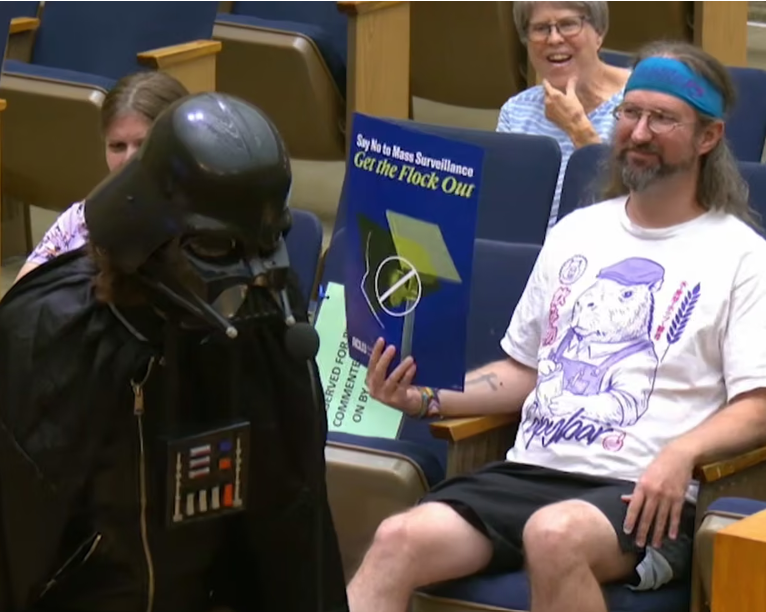
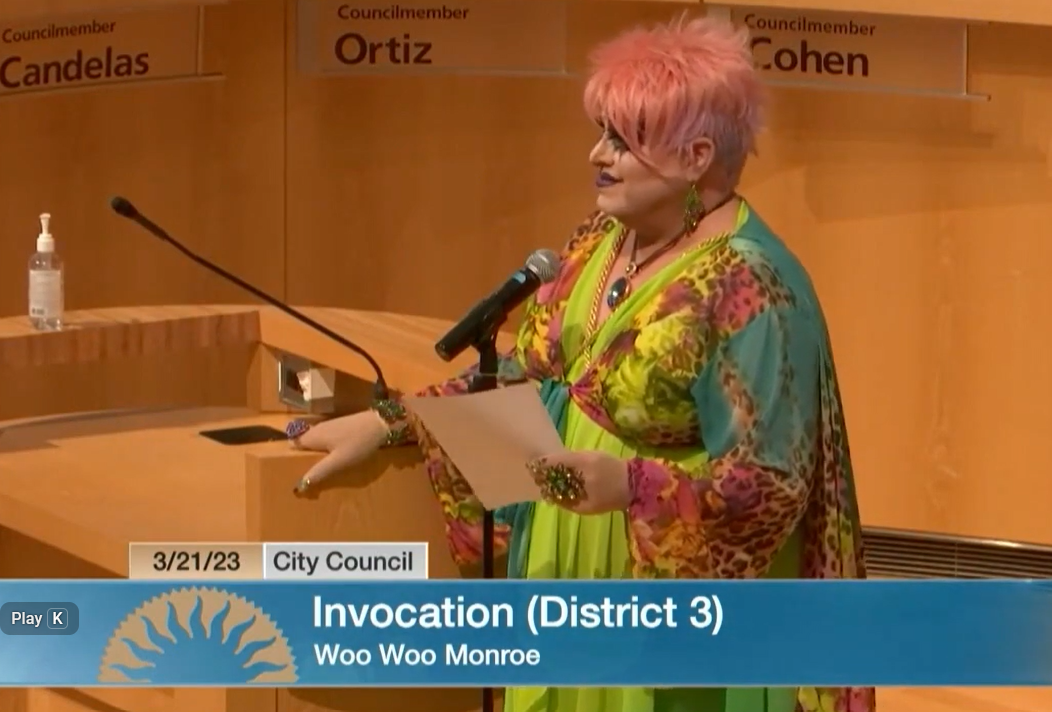
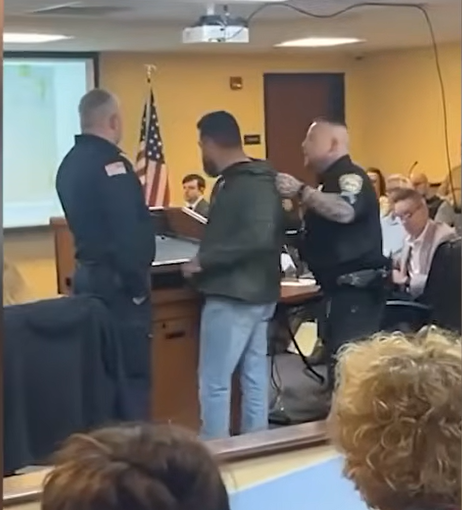
What about speaking anonymously or under a pseudonym? The First Amendment is said to protect the right to speak anonymously. Watchtower Bible & Tract Soc'y of New York v. Village of Stratton, 536 U.S. 150, 166-67, 122 S. Ct. 2080, 153 L. Ed. 2d 205 (2002); McIntyre v. Ohio Elections Comm'n, 514 U.S. 334, 341-42, 115 S. Ct. 1511, 131 L. Ed. 2d 426 (1995). However, that rule derives from written communication, whereas it is less clear that there is a right to speak anonymously at a public meeting. And among the recent instances of people being arrested related to commentary on data centers is an instance of a man getting kicked out of a meeting in Illinois merely for describing himself as a “concerned citizen,” and then being rather obviously falsely arrested for nonexistent “resisting.” And yet, in some cities, an individual can even make public comment while masked and using a pseudonym, which certainly seemed funny and clever when the speaker was “Darth Vader” criticizing Flock cameras, as shown in the pictures above, but might not seem quite so funny if the speaker were wearing, say, a mask of Hitler and making personal attacks on board members. There is currently litigation going on against the city of Nashua, New Hampshire around exactly this question of whether the First Amendment right to speak anonymously protects anonymous participation in public comment. This is also going to be a question that is complicated by the fact that many public meetings are now livestreamed with opportunities made for persons to comment from the online world, where speaking under pseudonymity or anonymity are more common.
Legal questions aside, it is also worth remembering is that it is bad to be a jerk, even when speaking to persons with whom one disagrees strongly, that the totality of reality is more complex than slogan-and-bumpersticker-type thought typically captures, and that it is not always a barrel of laughs to be a public servant. So the mere fact that the law may permit certain types of things to be said is not necessarily a good reason to say those things in the most pointed way possible. As Justice Frankfurter wrote back in 1944, the First Amendment guarantees us “the freedom to speak foolishly and without moderation.” Baumgartner v. United States, 322 U.S. 665, 673-674 (1944). But hopefully we can also exercise the good judgment to do otherwise.
To consult about a potential civil rights case, call today.