
Capitalization, Budgeting, and Income Prediction in an Idealistic Plaintiff-Side Law Practice
There is surprisingly little information published about the financial side of operating a plaintiff-side law practice, much less one that is idealistic or value-driven, such as a civil rights practice. If you go to a “business of law” seminar for plaintiffs’ attorneys, you will almost certainly hear a great deal about social media and AI and case management systems and the delights of medical treatment on a lien, but probably hear nothing about budgeting, or capital, or the expense of litigating. If you read the best-selling books on the business of plaintiff-side law, you may wonder if the authors somehow forgot to include a chapter about the money part: it is the elephant in the room, and it remains somewhat taboo to address it.
The best treatments of this area that I’ve seen are academic rather than popular. Professor Herbert Kritzer’s 2004 book Risks, Reputations, and Rewards: Contingency Fee Legal Practice in the United States, talks in depth about the basic idea that a plaintiff-side practice is, in essence, a portfolio of bets. And Professor Margo Schlanger has written in detail about the financial challenges of litigating on behalf of prisoners. Schlanger, The Just-Barely-Sustainable California Prisoners’ Rights Ecosystem, Public Law and Legal Theory Research Series Paper No. 469, July 2015. The only useful, popular treatment of plaintiff-side financial concerns I’ve encountered is in Pratik Shah’s excellent From Solo to Scale podcast, which addresses the challenges of capitalization in the beginning years of a personal injury practice, a subject I have not seen discussed elsewhere. (Thank you to both Professor Schlanger and Mr. Shah, who provided feedback related to this essay.)
I became curious about the financial piece while trying to make a career pivot. I spent more than a decade doing appointed postconviction work, which was economically simple to predict and steady if not especially lucrative by the standards of the legal world. At some point I grew restless, and started to take on small civil rights cases as a way to keep learning and growing.
I am not opposed to making money, but that was not my primary goal. The goal I set for myself was simply to break even over three years, to learn the craft, and to at least pay myself at the same modest rate that I earned doing postconviction work. Whatever happened next would sort itself out, I figured.
In making this transition, I had no law-world economic model. I had never worked at a firm. I have no lawyers in my family. My somewhat quirky working theory, instead, was that litigating a case against the police or a jail could be sort of like a band putting out its own records, as the famous Washington D.C. post-hardcore band Fugazi did, while also insisting that their shows be all-ages and never cost more than $5. You needed to dump in a few thousand dollars up front, or maybe you set a credit card on fire, but you could do it independently if you were serious. If you just worked hard and were creative and unconventional, you could earn your costs back or even make a profit.

The Price of Admission: the band Fugazi famously kept concert prices to $5 for most of their performing career, despite being both artistically and commercially successful. Photo by Timothy Earthling, from the Dischord records website.
Which turned out to be true, as far as it went. But this model has limits that I did not consider at first. These limits are worth thinking about for anyone who wants to go down this path, though more experienced legal entrepreneurs may consider them extremely elementary.
I had thought that, if I did well, I could gradually transition from a career in the postconviction world to a career doing civil rights. The reality is more complicated than that. The shoestring, DIY approach to civil rights litigation can in fact be a way to succeed in litigating individual cases. However, shoestring wins in a handful of modest cases are probably insufficient, in themselves, to be the foundation for a sustainable civil rights practice.
A Practice is a Pipeline
A sustainable law practice that functions as a viable career, as opposed to a hobby or a one-off project, needs a whole series of cases in a temporal pipeline. These cases typically require capital expenditures for some time before they ever generate any income. The acquisition process for cases is also competitive, so established firms, with good reputations and large advertising budgets, generally pull in the cases with the highest value and highest likelihood of success, leaving smaller players with cases that are legally quirkier, less lucrative, or both.
Additionally, law, unlike the world of independent music, is actively adversarial. On the plaintiffs’ side, you are going into battle against firms and public agencies with large budgets, squadrons of lawyers and support staff whose entire job is to make you lose, and a willingness to waste vast amounts of time purely for the sake of delay. Strategic asymmetries, scrappiness, and the bottom-line willingness to take the case to a jury are tactically powerful, but these factors won't pay the firm’s bills during years of discovery battles and interlocutory appeals.
Actually developing a civil rights practice, as opposed to merely financing one-off litigation a few times, consequently involves challenging problems of cash flow and capitalization. It takes a fair amount of capital to get even the smallest plaintiff-side practice operating steadily year over year, and it takes even more capital to drive a civil rights practice than a PI-oriented practice, because civil rights cases are less likely to settle and typically require significant litigation.
As I came to recognize this pragmatic reality, I considered various strategies for responding to it, discussed below. I am writing about all this here not because I have any brilliant solution but simply because, as I noted above, there is very little information out there in the world about this general subject. In spite of the challenges, I continue to want to run a “Fugazi”-style practice, one that is focused on my core areas of interest, and I continue to want to do it on my terms, not as an assembly line or a cash grab, but as a serious craft focused on cases that matter to me.
What might such a practice look like, in specific financial terms, and what principles can inform the strategy?
The Hypothetical Solo Firm, and The Continuum of Case Values
As Professor Kritzer details in his book, an operating plaintiff-side legal practice maintains a portfolio of cases that either pay out or fail at different points in time. Some cases might resolve relatively quickly – say, within a month or two of filing – whereas others might not settle until after surviving summary judgment. Still others might not settle at all, and might consequently need to go to trial and even through rounds of appeal, a process that could take many years.
Civil rights cases, which usually involve the potential for fee-shifting, can have a higher valuation than a pure personal injury case, for a given sort of harm, and they might even be cases that involve only nominal harms, where the entire value to the lawyer would consist of a hypothetical post-trial fee award. This can make it somewhat tricky to assign value to civil rights cases, since they are not as easily quantifiable as PI cases. In any case, let’s posit the following:
Assume a lawyer in solo practice, operating mostly virtually to keep costs down. The lawyer’s standard contract calls for 33% of a settlement and recovery of costs. (Some lawyers in Southern California have contracts that call for 40%, while FTCA fees are capped at 25%. Let’s stick with 33% for the sake of this exercise.)
Lower value settlements might be in the range of $50,000, with the lawyer’s share being $16,500.
Middle value settlements might be in the low six figures, with $200,000 being perhaps a fair ballpark. One such case would net the lawyer $66,000.
Higher value settlements would be in the seven figures. A $1,000,000 case would net the lawyer $330,000.
Here again, the values are somewhat arbitrary. The point is simply that there is a range of potentially viable cases that extends from some relatively low number (perhaps even as low as $1 in a nominal damage case) up to roughly seven figures.
Upside is Not Proportionate to Litigation Cost or Attorney Labor
One thing that is apparent from this simple framework is that high value cases are not just worth somewhat more than lower value cases: they are worth massively more. The lawyer would have to resolve 6 lower value cases each year, for more than three years, just to approach the amount of money that the lawyer would make by resolving a single higher value case. That’s obvious, in a way, because a $1 million case is worth 20 times as much as a $50,000 case, but the point is that the $1 million case generally does not take anything like 20 times as much work as the $50,000 case.
In fact, a $1 million case can sometimes take less work, because some high value cases are so factually compelling that they essentially sell themselves. Even if the higher value case is significantly more complex than a low value case, the increase in upside can easily be multiple times the increase in the amount of work. Negotiating over $20,000, meanwhile, can take exactly the same amount of time and aggravation as negotiating over tens of millions of dollars.
The cost of litigating cases, in terms of cash outlay, also does not increase nearly as dramatically as the potential value of the cases, both because the costs increase only somewhat as complexity increases and because the costs are mostly recoverable under most contracts. Virtually all civil rights cases, whether they are worth $1 or $1 million, need to be filed as lawsuits and served on the defendants (some firms with strong reputations can reach pre-lit settlements, but that is much less common in the civil rights realm than in the world of PI, where it is routine), all of which will cost in the range of $600 to $1,000(ish), depending on the number of defendants to be served.
If the case goes through discovery, several depositions will need to take place, and a reasonable budget for that process might be $5,000 to $20,000. And there may need to be experts, which in a relatively straightforward case could add somewhere between $2,500 and $10,000 for initial reports. So the cost of litigating a single case through summary judgment will range between perhaps $5,000 or $6,000 on the low end to roughly $30,000 on the higher end. Cases involving complex medical issues or the need for technical studies are obviously going to be substantially higher, but setting those aside let’s assume $12,500 as a rough per-case figure.
How does this all come together in a model of a practice, and what does the model imply?
The Modest, Base-Hits Portfolio: An Economic Plateau
My original theory of how I would practice in an idealistic way was simply to litigate a modest number of civil rights cases every year involving interesting constitutional issues. But operating in this way does not necessarily build a “practice” at all in the sense of generating steady income that can support even a single attorney. This approach takes both a considerable amount of work and the investment of a fair amount of money, but it can end up generating less profit, on an annual basis, than the salary of most first-year associates.
To illustrate, suppose a firm’s portfolio consists of 10-to-15 low- and medium-value cases, with a mean value to the firm of $41,250 (derived as the average of the low and medium value cases posited above). Suppose a third of the portfolio resolves in any given year, producing 3-5 settlements annually, for a gross of between $123,750 and $206,250.
Litigating those same 10-15 cases will require a total capital outlay of between $120,500 and $187,500, given the cost assumptions detailed above. If those costs are also spread out over three years, annual litigation costs would come out to between $40,166 and $62,500. However, costs are typically recoverable against the payout from a case, assuming the case does not lose at some point. In practice, the handling of costs can end up being a bargaining tool in settlement and/or a lawyer may end up eating costs for other reasons, taking the equities of a case into account. So assume that 75% of costs (but not fully 100%) can be recovered.
Assume at least another roughly $20K/year in other costs for things like legal research, supplies, group memberships, computers, and some sort of minimal office or mailbox space. (Again, the costs could be dramatically different, particularly if there is a substantial spend on advertising or payment of significant referral fees, but these are just figures for the sake of the exercise.)
The annual costs to operate the practice would effectively be $30,042 to $35,625, netting the firm $93,709 per year from the 10-case portfolio scenario and netting the firm $170,625 per year in the 15-case portfolio scenario.
In table form, it looks like this:
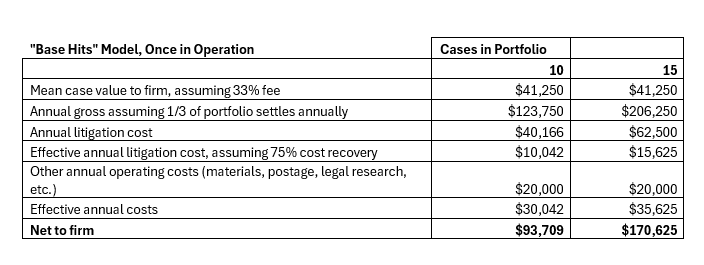
You may feel that these numbers are way too low or way too high: it all depends on a lot of assumptions. If you want to tinker with the case values, the litigation costs, or overhead costs, here is a version of the table that you can edit, which needs to be viewed on desktop rather than mobile. (Note that the numbers for my 10-case scenario in the table above are based on 3 settlements annually rather than 1/3 of the portfolio, which would be 3.3/year.)
The hypothetical attorney operating such a practice, who has to pay himself or herself a salary from the money that the firm nets, would not really derive much, if any, financial benefit from doing so, compared to simply being an employee of a more established operation, though there might be benefits in terms of work flexibility and the ability to pick and choose cases. Considering the difficulty and risk of pursuing this approach, and the fact that the practice will tie up tens of thousands of dollars of capital, most lawyers would probably not find this to be a good tradeoff if the practice remains stuck in this economic plateau.
The plateau was the piece I did not foresee about trying to do civil rights “like Fugazi”: an idealistic commitment to taking on difficult and modestly valued cases can “succeed” on a case by case basis but simultaneously fail to build toward any greater economic return. It can be a fairly poor financial strategy compared to any number of alternative legal career paths.
In fact, though the number of cases in these hypothetical portfolios might look small to some, my actual practice involved even fewer cases than that, because I just did not have that many promising cases coming through the door – I am admittedly skeptical about most potential civil rights cases, because the legal landscape is extremely unforgiving – and I was not sure what my ability might be to handle the demands of the litigation. So the income I was generating, viewed on an annual basis, looked even worse than this example, and could never become self-sustaining. My firm was not really developing a civil rights “practice,” as an economic matter. Really I was just dabbling in the field.
How could the firm move past that?
Alternative 1. The PI Model: Increase Portfolio volume, Add Expenses on Support Staff and Advertising
One path out of the plateau is that emphasized by virtually all the “business” literature on plaintiff’s side law practice and by the billboard lawyers – namely, to increase case volume by signing more cases. Fairly quickly, this will require support staff, and it will require advertising, and it will look considerably less like “civil rights,” such that the original idealism of the practice is, at the very least, changed substantially in focus. Assuming the cases are still low-to-medium value, and assuming litigation costs per case stay the same on average, but adding one support person at a cost of $100,000 and spending $50,000/year on advertising, the numbers look like this:
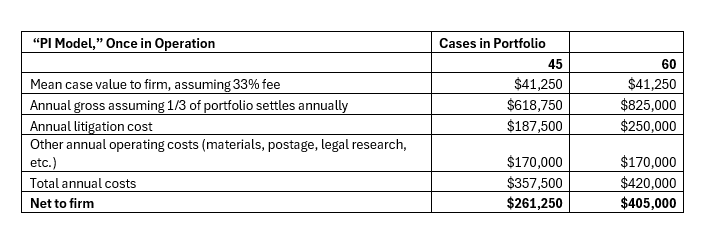
Realistically, the advertising costs may be considerably higher, and there are probably additional costs that start to be necessary in this model, such as a more professional office space. But the basic point is just that increasing the case volume increases profits, because the costs of litigating each new case are not that high and most litigation costs are recoverable in any event.
I have no idea whether any firm actually could maintain anything like this volume of even moderately good civil right cases, regardless of how well it advertised. Maintaining 60 cases in the portfolio would mean adding 20 new cases each year, a new case almost every two weeks. At this kind of scale, the work is likely to begin resembling more of a traditional personal injury firm simply because those cases are more common. It’s not exactly a “mill,” but it seems quite removed from anything like the “Fugazi” approach, and it would certainly be difficult to have much personal connection with so many clients or a deep understanding of their cases, if that were important to the lawyer.
Alternative 2. Pursue “Home Runs” By Pursuing Higher Value Cases and/or Going to Trial More Aggressively.
A second and probably more attractive path out of the economic plateau is by pursuing “home run” outcomes that skew dramatically higher in value, even if the overall case volume does not increase substantially. One way this can occur is via resolving high-value cases, which may then fund the costs of an entire portfolio of cases for years going forward. But before one can resolve such cases, one has to sign those cases in the first place, and there is a considerable amount of competition for these cases from the big fish in any given legal pond.
In civil rights practice, there is another path to the “home run,” one that is more open to our idealistic firm. The fee shifting statutes that are often at issue in civil rights cases mean that winning at trial, and thereby triggering the right to recover fees and costs from the defendant, can flip even an apparently “low” value case into one that is worth a significant amount of money to the lawyer. That can occur even if the value to the plaintiff is relatively low. There is consequently a real advantage to plaintiff’s counsel to taking cases to trial often, even if some cases will lose. Moreover, going to trial often will encourage higher settlement values in other cases, so a “loss” in a low-valuation trial may actually be a net gain for the firm because of the effect on reputation.
If a lawyer with the low-to-moderate-value portfolio sketched above could take even a single case to trial every year, it would tend both to increase the value of the entire portfolio and create the potential for “home run” fee awards. It is difficult to quantify this effect because the value of a win necessarily depends on what work was done in working up the case and the hourly rate the lawyer can command in a fee petition – and most of all because loss at trial is not uncommon – but suppose that a single “base hit” case that would have otherwise been worth $41,250 produces a fee and cost award of $200,000. Suddenly the model looks more attractive.
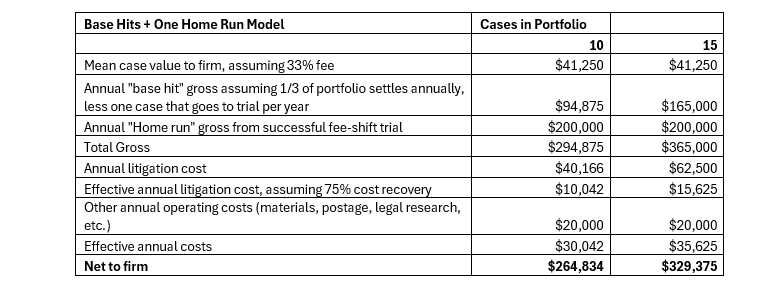
However, cases that go to trial will also sometimes lose, which might generate a year that looks like this:
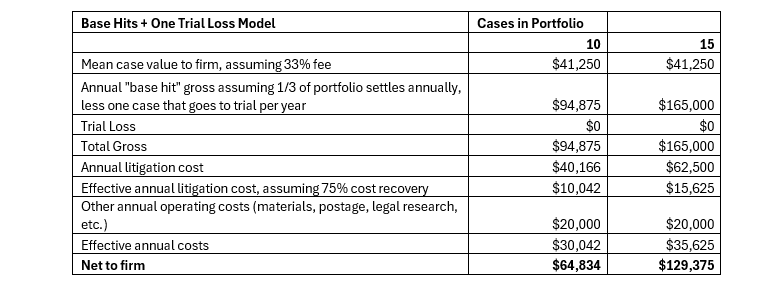
Moreover, even “home run” trial successes carry their own risk of delaying time to payout based on post-trial motions, appeals, and so on.
The financial importance of the “home run” also illustrates why the PLRA is so damaging to prisoners’ ability to get counsel: namely, that capping fee awards at 150% of damages and severely limiting hourly rates (see 42 U.S.C. § 1997e(d)) means that there is no way to convert a “base hit” case into a “home run” in most prison litigation, at least in federal causes of action, even if the lawyer manages an improbable win at trial. Such work is righteous, but it cannot be the mainstay of a viable practice, unless there is some way of avoiding PLRA caps. Professor Schlanger, whose writing is mentioned above, quotes Michael Bien of California prison litigation stalwart Rosen Bien Galvan & Grunfeld as saying “We don’t bring a prison or jail suit now without having some solid non-PLRA covered claims.”
Alternative 3. Hybrid Practice.
A third approach, which many civil rights lawyers seem to employ, and which I essentially ended up using by default, is to offset the moderate income and uncertain cash flow of a modest civil rights practice with other practice areas where the financial fruit hangs a little lower and there is a prospect of steadier pay: often either criminal defense or PI. Alternatively, an attorney could moonlight in civil rights while working in a nonprofit or academic position.
Maintaining this type of approach allows the lawyer to keep the possibility of the “home run” case in the mix without relying on a pure civil rights portfolio to pay the bills at all times. Notably, however, even in a hybrid model, the “home run” is probably not ever going to materialize without going to trial. Taking a handful of low-to-moderate value cases from time to time and settling them might be intellectually interesting or morally invigorating, and it might even provide a little extra spending cash on occasion, but it is unlikely to be financially transformative.
Capital Demands
In addition to the challenge of generating adequate income, any portfolio that actually functions as a self-sustaining practice must address a problem of adequate capitalization through startup. Operating this hypothetical practice, at any level, costs money. In the cost models sketched out above, the firm was depicted as being already in steady operation. When a practice is just developing, however, the costs are not spread out evenly, and they pile up quickly prior to receipt of any revenue.
If, for example, the firm were to sign up five new cases in a single year in an attempt to gradually develop the 15-case portfolio of our “base hits” model, there would likely be a period, several months later, where several of these cases were in discovery and, not long after that, where the firm would be receiving invoices that amount to a substantial fraction of the entire case cost. And in the first year, very little revenue will be coming in to pay for any of that, or to pay for anything resembling a salary.
The second and third year for the startup firm might be a little better, but in all likelihood it will be a multi-year process, involving a sustained injection of capital, before the practice can begin to produce even the modest numbers of the “base hits” scenario. Several of the interviewees in Pratik Shah’s podcast, most of whom are from the personal injury world, describe going through exactly this pattern of several extremely challenging years in starting their practices.
Here’s how those finances could look, even assuming the lawyer is initially drawing only a 30k salary while living a hyper-idealistic ramen-and-futons lifestyle or is supplementing their income via some other source. Assume that in any given group of five cases, one will resolve in the first year it is signed, with recovery of the expenses incurred in that year, one will resolve in the year after it is signed, with recovery of two years of expenses, two will resolve in year three, with recovery of three years of expenses, and one will fail, with the revenue looking like so:
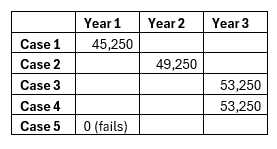
Using those revenue assumptions and the other cost assumptions we sketched out earlier, the first three years look like this:
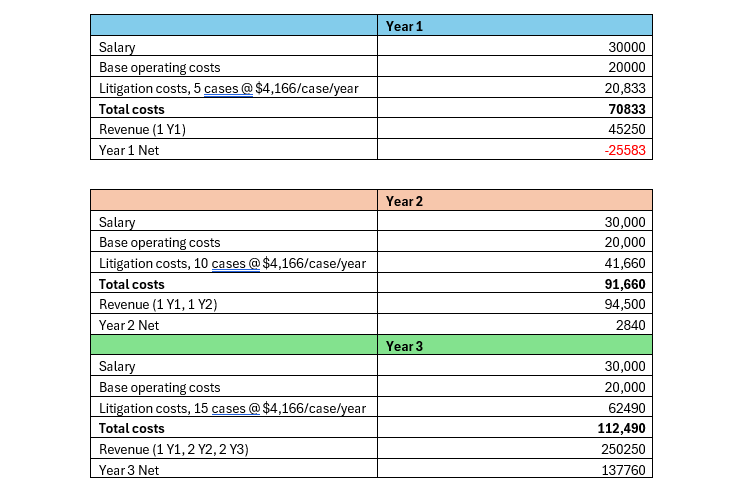
In short, the first 2 years are likely to be brutal, and even the third year only begins to resemble what the lowliest associate with defense counsel’s firm was probably making from day one. It’s possible to invest less up front, and that is what I did by having a smaller portfolio of cases, but that also made it less likely that I would build toward any kind of serious return or self-sustaining practice over time.
For most people, investing this kind of money, time, and effort only makes sense if the numbers will eventually look better than the “base hit” scenario, and hopefully will look substantially better. That can occur, but it is important to understand just how much has to be sacrificed to get a civil rights-based firm afloat at all. There needs to be a conscious strategy to move beyond the economic plateau if the investment of time, energy, and capital is not merely producing returns that plod along over time, underperforming more mainstream legal careers.
Conclusion: CHALLENGES, BUT ALSO OPPORTUNITIES
Law is not a Fugazi show: it does not cost just $5 to get in the door. It is a thoroughly grown up playing field, with stakes to match and capital requirements that can easily cost a person their ability to sleep well at night. But civil rights nevertheless has certain affinities with the world of scrappy bands who refuse to play by the rules. It requires a kind of contrarian, punk rock pugnaciousness to see the merits in some civil rights cases and to recognize, in the face of the defense’s representations that you are insane, that jurors might be able to see those merits as well.
The intriguing thing, for the lawyer who wants to operate an idealistic practice, is how powerful the role of going to trial is as an economic lever. Going to trial is the tactic that simultaneously gives a real voice to the concerns of the client, creates the potential for “home run” results for the firm, and increases the reputation of the firm such that higher-value cases and settlements can become a reality downstream.
How, specifically, a practice should operate or what the values or monetary targets should be of the practice is a question each firm operator must decide on their own. Even what I have described as a “plateau” here could, from another point of view, simply be thought of as a practice that prioritizes meaningful work over economics, such as by advocating on behalf of politically disfavored groups or taking up the causes of the incarcerated in spite of the constraints of the PLRA.
The point is simply that if a firm wishes to move beyond that fairly modest economic space, there are specific financial challenges to doing so. However that calculus looks in any particular case, the civil rights lawyer will benefit from recognizing the unique financial challenges and opportunities of the field and, in particular, the power of fee-shifting, even in cases that seem “small.”