
A first grader who was given a talking-to by her school principal and told to apologize after giving a controversial drawing to an African-American classmate had a viable First Amendment retaliation claim, the Ninth Circuit concluded this week in B.B. v. Capistrano United School District.
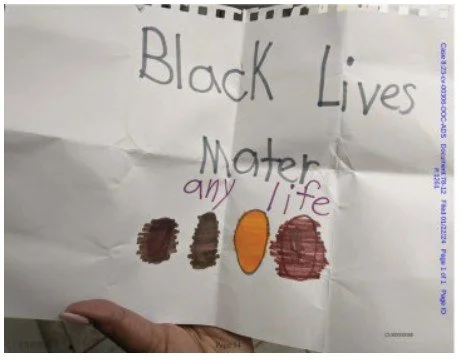
Drawing Conclusions: The first-grader’s drawing that gave rise to this dispute.
The first grader, B.B., made the drawing after a book was read to the class that had to do with the Black Lives Matter movement. She stated that “she included the phrase ‘any life’ in her drawing because ‘all lives matter,’ ” and she gave it an African-American classmate, M.C. The classmate, who was the only Black child in the class, took the drawing home, where it was found by the classmate’s mother. After the mother raised concerns with the school, the school principal then “took B.B. aside and told her that the drawing was ‘not appropriate,’ she was not to give drawings to other students, and she should apologize to M.C. B.B. thought that [the principal] used the word ‘racist’ to describe the drawing but could not remember for sure.” B.B. may also have been prohibited from going to recess, thought the evidence on this point is unclear.
The District Court had granted the school district’s motion for summary judgment, concluding that the drawing was not protected by the First Amendment. The Ninth Circuit reverses, applying the standard of Tinker v. Des Moines, 393 U.S. 503 (1969), which typically inquires whether expression caused “substantial disruption” at school but also contains language emphasizing that schools can act to protect students’ rights “to be secure and to be let alone.” Applying that “let alone” language, the Ninth Circuit concludes that schools can regulate student speech “when it involves derogatory and injurious remarks directed at students’ minority status such as race, religion, and sexual orientation.” (Internal quotations omitted.)
In this particular case, the appellate panel notes, there is conflicting evidence both as to whether there was a need to protect the student’s right to be let alone (M.C., the Black student, herself apparently did not give much thought to the drawing) and about whether the author of the drawing was in fact “punished” in any way. So the case needs to go to a jury, or at least it is not appropriate for resolution by summary judgment.
This is another case that strikes me as addressing quite a tricky area. Schools are in a difficult position because they can have legal exposure both if they don’t act (and thereby fail to protect a student from what they understand to be bullying) and if they do act. But it’s also tricky because students do not necessarily have a right, even under the “let alone” clause, to have schools insulate them from any perspective that they may find disagreeable or uncomfortable, and in some ways coming to appreciate differing perspectives on challenging issues is part of what an education is intended to deliver. So the question is how, as a practical matter, the “let alone” clause can be applied in a manner that simultaneously respects the intensely personal nature of some types of discussion and the fact that people may reasonably have differing perspectives on contentious issues, even when they have those sorts of personal impacts.
In Harper v. Poway United School District, 445 F.3d 1166 (9th Cir. 2006), which was later vacated as moot by the United States Supreme Court, the Ninth Circuit previously concluded that a school could sanction a student for wearing a t-shirt that disapproved of homosexuality on a day that the school had designated as a “day of silence” intended to "teach tolerance of others, particularly those of a different sexual orientation.” Harper is the source of the language that B.B. cites regarding comments on race, religion, and sexual orientation, and has been invoked by other school district defendants to assert that “California schools have an obligation to protect students from psychological assaults that cause them to question their self worth.” See J.C. v. Beverly Hills Unified Sch. Dist., 711 F. Supp. 2d 1094 (9th Cir. 2010).
This strikes me as a complicated proposition at best, because controversial subjects may well bear on the “self worth” of a person who is part of a group being discussed: that’s exactly why they are controversial. I am somewhat skeptical that the Ninth Circuit’s interpretation of Tinker’s “let alone” clause as applying to expression on a particular set of subjects — race, religion, and sexual orientation — would survive review by the United States Supreme Court if certiorari were granted. Difficult to know for sure!
Related Post: Canyon Crest Elementary and First Amendment Issues at School.
To consult about a potential civil rights case, call today.