Ninth Circuit Sees First Amendment Issue Stemming from First Grader's Expression Punished by School

A first grader who was given a talking-to by her school principal and told to apologize after giving a controversial drawing to an African-American classmate had a viable First Amendment retaliation claim, the Ninth Circuit concluded this week in B.B. v. Capistrano United School District.
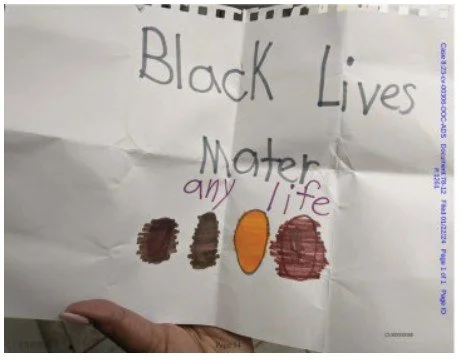
Drawing Conclusions: The first-grader’s drawing that gave rise to this dispute.

The first grader, B.B., made the drawing after a book was read to the class that had to do with the Black Lives Matter movement. She stated that “she included the phrase ‘any life’ in her drawing because ‘all lives matter,’ ” and she gave it an African-American classmate, M.C. The classmate, who was the only Black child in the class, took the drawing home, where it was found by the classmate’s mother. After the mother raised concerns with the school, the school principal then “took B.B. aside and told her that the drawing was ‘not appropriate,’ she was not to give drawings to other students, and she should apologize to M.C. B.B. thought that [the principal] used the word ‘racist’ to describe the drawing but could not remember for sure.” B.B. may also have been prohibited from going to recess, thought the evidence on this point is unclear.

The District Court had granted the school district’s motion for summary judgment, concluding that the drawing was not protected by the First Amendment. The Ninth Circuit reverses, applying the standard of Tinker v. Des Moines, 393 U.S. 503 (1969), which typically inquires whether expression caused “substantial disruption” at school but also contains language emphasizing that schools can act to protect students’ rights “to be secure and to be let alone.” Applying that “let alone” language, the Ninth Circuit concludes that schools can regulate student speech “when it involves derogatory and injurious remarks directed at students’ minority status such as race, religion, and sexual orientation.” (Internal quotations omitted.)

In this particular case, the appellate panel notes, there is conflicting evidence both as to whether there was a need to protect the student’s right to be let alone (M.C., the Black student, herself apparently did not give much thought to the drawing) and about whether the author of the drawing was in fact “punished” in any way. So the case needs to go to a jury, or at least it is not appropriate for resolution by summary judgment.

This is another case that strikes me as addressing quite a tricky area. Schools are in a difficult position because they can have legal exposure both if they don’t act (and thereby fail to protect a student from what they understand to be bullying) and if they do act. But it’s also tricky because students do not necessarily have a right, even under the “let alone” clause, to have schools insulate them from any perspective that they may find disagreeable or uncomfortable, and in some ways coming to appreciate differing perspectives on challenging issues is part of what an education is intended to deliver. So the question is how, as a practical matter, the “let alone” clause can be applied in a manner that simultaneously respects the intensely personal nature of some types of discussion and the fact that people may reasonably have differing perspectives on contentious issues, even when they have those sorts of personal impacts.

In Harper v. Poway United School District, 445 F.3d 1166 (9th Cir. 2006), which was later vacated as moot by the United States Supreme Court, the Ninth Circuit previously concluded that a school could sanction a student for wearing a t-shirt that disapproved of homosexuality on a day that the school had designated as a “day of silence” intended to "teach tolerance of others, particularly those of a different sexual orientation.” Harper is the source of the language that B.B. cites regarding comments on race, religion, and sexual orientation, and has been invoked by other school district defendants to assert that “California schools have an obligation to protect students from psychological assaults that cause them to question their self worth.” See J.C. v. Beverly Hills Unified Sch. Dist., 711 F. Supp. 2d 1094 (9th Cir. 2010).

This strikes me as a complicated proposition at best, because controversial subjects may well bear on the “self worth” of a person who is part of a group being discussed: that’s exactly why they are controversial. I am somewhat skeptical that the Ninth Circuit’s interpretation of Tinker’s “let alone” clause as applying to expression on a particular set of subjects — race, religion, and sexual orientation — would survive review by the United States Supreme Court if certiorari were granted. Difficult to know for sure!

Related Post: Canyon Crest Elementary and First Amendment Issues at School.

To consult about a potential civil rights case, call today.

1994 Again: The Gathering Clouds of the "Tough on Crime" Storm

As the country staggers back from covid and the major parties float various talking points ahead of the 2022 midterms, it is beginning to feel a lot like we are moving forward into the past. Moving, specifically, into 1994.

Then-Senator Biden in 1994

Then-Senator Biden in 1994

The parallels are not hard to see. We have a drumbeat of reports that crime is on the rise, with at least some basis in truth in the area of violent crime (though not much context). We have a looming midterm election in which Republicans will attempt to pin this trend on a Democratic president and a Democratic House majority. And (as is always the case when we are talking about crime) we have a strong underlying current of racial resentment, with white anxiety over the Black Lives Matter movement, 2020 demonstrations, and “defund the police” campaigns not far from the surface.

Similar factors were at play going into the 1994 midterms. Democrats controlled the presidency and both houses of Congress, but crime (which was at significantly higher levels in the 90s than it is today), was a substantial concern. The infamous 1994 Crime Bill, which then-Senator Biden supported, was signed into law by President Clinton in September of 1994, just two months before the midterm elections. Decades later, the country is still working to sort out the impacts of the wave of incarceration that this legislation helped create.

A lot of crime policy, of course, is a product of state and local politics, rather than federal politics. But there is an interplay between the local and national stages because of the way local issues get spun into national narratives. Here in California, there are several dynamics that may lends themelves to a “tough-on-crime” narrative despite (or perhaps because of) the fact that the state is more progressive than many other parts of America. First, California has seen the rise of the “progressive” prosecutor in figures like Chesa Boudin in San Francisco and George Gascón in Los Angeles. Both of these DAs have instituted policies that put them strongly at odds with law enforcement unions, and Gascón is facing a recall effort. (Boudin is as well, though the effort appears to be floundering.) California has also undergone several waves of legislative reform aimed at reducing overincarceration, including changes to its Three Strikes law and the 2014 passage of Prop. 47, which deprioritized low-level property crime. If you wonder why there is constant harping in the media about whether Walgreens in San Francisco is seeing a lot shoplifting, this is the reason: because such shoplifting is intended to be a concrete example of the “failure” of Prop. 47 and progressive crime policy more generally. (Never mind what the data actually shows, which is that shoplifting is down in San Francisco from where it was in 2018 and 2019 when nobody was talking about it.)

shoplifting.JPG

The same is true regarding the recent reporting on the California Department of Corrections and Rehabilitation releasing certain inmates, and prosecutors’ attempts to legally block those releases: these are things California voters approved years ago via Prop. 57, and they are not a surprise. They are scarcely even “news” at all except for the fact that events in the world of crime often treated by the media as having no context. But that doesn’t mean these releases can’t be spun into a national-level story that can be used to influence outcomes in other areas.

California is a relatively liberal state, and it seems unlikely that the majority of California voters are going to substantially abandon the course of the last several years and retreat to “tough-on-crime” policies of the sort we saw in the ‘90s. But what we almost certainly will see is a pronounced effort at the national level to argue that the “failure” of California criminal justice policies, especially in San Francisco and Los Angeles, requires electing conservatives to Congress. It wouldn’t be surprising, in fact, if we saw an attempt to retool Newt Gingrich’s 1994 “Contract with America” as a conservative positioning piece ahead of 2022, with crime policy occupying a central place in such a contract. (Gingrich himself has apparently suggested that he should do this in collaboration with the former president, though It’s unclear that anybody really wants to dance with Gingrich again.)

Another unfortunate thing we are basically guaranteed to see in the months ahead is the local crime story out of SF or LA that gets magnified by Fox et al. into a national referendum on Democrats’ purported “weakness” on crime. There will be some sort of unpleasant violent crime committed by an immigrant or a person of color, and it will be Willie Horton-ized into the type of dog-whistle politics that are so often cited in calls to crack down.

The really challenging question is how Democrats will respond to this dynamic. In the ‘90s, it wasn’t even a question: they shamelessly flogged the tough-on-crime narrative, throwing communities of color under the bus via both the 1994 crime bill and the 1996 passage of AEDPA, which effectively eviscerated federal review of state convictions. Biden, perhaps not surprisingly, has already begun signaling his tough-on-crime credentials again. His rhetoric, about “taking on the bad actors doing bad things to our communities” almost sounds like another politician’s comments about certain “hombres,” though surely (?) he doesn’t mean it that way. It seems likely that Democrats in vulnerable districts may want to adopt similar approaches as we enter the midterm whirlwind. But Democrats may also be somewhat constrained by the evolving demographic and political realities of our nation and even, one hopes, by at least some glimmer of conscience. It may be harder to be crudely “tough on crime” when the politics of racial scapegoating no longer play as well as they did a quarter century ago.

Study Highlights Impact of Race in San Diego Police Use of Force and searches

A study released Thursday by the Center for Policing Equity shows black San Diego residents are subjected to police force 4.8 times more often than white San Diego residents. Other studies, including one released in 2020 by KPBS, have shown similar patterns. SDSU researchers found the same problem in a study released in 2017, but the city was reported to have pressured the authors to water down the language of the study’s findings by, for example, changing the word “bias” to the word “disparities” in more than two dozen instances.

Black and LatinX San Diego residents are also more than twice as likely to be searched by police after being stopped than white residents, according to the new CPE study.