Government Speech vs. Compelled Private Speech

When the California Medical Board requires a private continuing medical education (CME) provider to include curriculum on implicit bias in medicine, is that government speech or is it compelled private speech that runs afoul of the First Amendment?

Oh Doctor, I’m Damaged: Whether speech is treated as “private” or “government” in nature can be a tricky boundary to draw when the government is exerting control over what a private actor must or must not express. Photo by National Cancer Institute on Unsplash.

A panel of the Ninth Circuit previously concluded in Khatibi v. Hawkins that it was government speech, and thus not subject to First Amendment protections, in spite of the plaintiffs’ arguments that the government was improperly forcing them, as individuals, to express a viewpoint with which they disagreed. Now the Ninth Circuit has denied en banc rehearing of that decision, and there are some spicy dissents from that denial, which argue that the panel got the analysis wrong.

As a side note, the notion that “implicit bias” in medicine is controversial or problematic as an idea strikes me as incorrect. Implicit bias exists throughout life, not because people are intentionally racist or bad but simply because we tend to favor people who appear to fit with our own vision of the world and our sense of who we are, and implicit bias unquestionably affects the way medicine is delivered. If you happened to see that recent appalling viral video of an African-American woman in Dallas being ignored while in active labor in a waiting room, that was a good example, but there is also plenty of empirical research on the subject. Implicit bias is a real and powerful thing.

But put that to the side. Suppose the content of the mandated expression is not about implicit bias, but rather about the historically misleading ideas that have been advanced by the current administration around the treatment of African-Americans under slavery. Now what? For the sake of argument, would it still be okay to require private CME providers to give voice to those perspectives?

In general, there are fairly narrow limits on what sorts of speech the government may compel a private actor to express: compelled private speech is subject to strict scrutiny, which is why we get cases like 303 Creative, where the Supreme Court concluded that a website designer could not be forced to make a website for a same-sex marriage, in spite of the state of Colorado’s public laws prohibiting businesses from discriminating. The implicit bias content in Khatibi probably would not pass strict scrutiny if it were regarded as private speech, since there are plenty of other ways that the Medical Board could convey its message to doctors without requiring a private CME provider to express that message.

The idea of the Khatibi panel is that the CME curriculum is government speech rather than private speech, and is thus exempted from First Amendment protections. The panel wrote: “when California—from beginning to end—dictates, controls, and approves the provider, form, purpose, and content of CMEs, it is in fact the State that ‘speaks’ or expresses its views.” The panel compares this case to one that upheld mandatory funding of beef commercials by cattle ranchers and another that upheld Texas’ refusal to permit a specialty license plate featuring the Confederate flag. The dissenters from en banc rehearing, on the other hand, emphasize that there is a very broad degree of freedom given to CME providers about what their curriculum will be, except in this particular area, and thus that CME speech is unlikely to be perceived as “government speech” in the way that, say, a license plate would in the Texas case.

For free consultation about potential civil rights cases, call today.

First Amendment Retaliation Based on School Administrator's Derogatory Facebook Post

A derogatory and threatening political Facebook post by an assistant principal at a middle school could validly be the basis for adverse employment action against the poster, given the District’s interests, the Ninth Circuit concluded this week in Thompson v. Central Valley School District No. 365.

A proper education? Woodshed photo by Kevin Jarrett on Unsplash.

The assistant principal’s post, made in response to the 2020 Democratic National Convention, referred to “Demtards” and called Michelle Obama a “hatefull racists bitch” (sic). He further suggested that Democrats needed to be taken “to the woodshed for a proper education.” When the post was reported and investigated, the assistant principal claimed his Facebook account had been “hacked,” but had no evidence to support that claim. The District transferred the assistant principal, who then sued for First Amendment retaliation.

This type of case — in which a public employee claims to have experienced retaliation for protected speech — is analyzed under Pickering v. Bd. of Ed. of Twp. High Sch. Dist. 205, 391 U.S. 563, 568 (1968). Under Pickering, if the plaintiff is able to make a prima facie showing that adverse action was taken on the basis of protected speech, the defendant must then show either “(1) that its legitimate administrative interests in promoting an efficient workplace and avoiding workplace disruption outweigh the plaintiff’s First Amendment interests; or (2) alternatively, the government would have taken the same actions absent plaintiff’s expressive conduct.”

Here, the District Court concluded that the School District met its burden on the second step of the Pickering analysis, and the Ninth Circuit affirmed. The Ninth Circuit emphasized that the “derogatory” nature of the post and the implied violence of his reference to the “woodshed” matters in that second-step calculus, meaning that the speech was not entitled to the highest degree of protection. The District’s interests, on the other hand, were weighty given that the plaintiff was in a public-facing role and seemed to be broadcasting views inconsistent with the District’s expressed values. His “derogatory and violent language could substantially disrupt the orderly operation of the school,” even when expressed by this individual on a personal Facebook account.

This particular situation does not seem like too difficult an application of Pickering because of the concerns emphasized by the appellate court, but you can see where a public agency’s commitment to somewhat vague values like “inclusivity” and “tolerance,” and the argument that private speech interferes with those values, could potentially get into more ambiguous terrain. Suppose, for example, a public employee posts something on a personal page agreeing with a “derogatory” sentiment of the current president. What then?

Related Posts: Canyon Creek Elementary and First Amendment Issues at School

For free consultation about potential civil rights cases, call today.

Parental Rights and State Speech about Transgender Youth: Two Cases

Two recent federal cases, one in the Ninth Circuit and the other in the District Court, have grappled with the challenging question of what approach government officials must take in communicating with parents when youth present at government facilities in a gender-nonconforming way.

Both cases emerge from challenges to rules that restrict state actors from communicating with parents about these gender-related issues. In International Partners for Ethical Care Inc. v. Robert Ferguson, decided in early December by the Ninth Circuit, the law at issue was from the state of Washington and related to government employees of shelters and mental health care services. Whereas in Mirabelli v. Olson, decided shortly before Christmas, the case arose from a policy of the Escondido School District that was modeled on a policy developed by the California Department of Education.

In each case, the underlying idea of the policy or law is (or was: Escondido has changed the policy since the case started) to limit officials from communicating with parents about the fact that a youth appears to be gender-nonconforming. In International Partners, the plaintiffs lost on the grounds that they did not have standing to challenge the rule, and the Ninth Circuit upheld that loss, but some judges wrote strongly worded dissents from the denial of en banc rehearing, emphasizing parental rights to be informed about their children. In Mirabelli, on the other hand, the plaintiffs prevailed (at least for now, in the District Court), obtaining an injunction that bars the government from permitting or requiring educators to mislead parents about the child’s gender presentation, such as by referring to the child by different names/pronouns at school than in communication with the parent.

This area of the law strikes me as quite a tricky balance to strike. On the one hand, I strongly support the right of young people to live as they wish, including in gender-nonconforming ways, and there is a real concern that “outing” a young person to his or her parents as gender-nonconforming could lead to abuse or other forms of harm. On the other hand, there are complications to mandating theoretically “virtuous” silence or affirmative misrepresentation around these issues, because not everybody agrees on what virtue consists of, and government employees themselves have constitutional rights that deserve respect. Meanwhile, parents themselves historically have a strong interest in what they believe to be the welfare of their children, and that substantive due process right is not one that can be disregarded lightly. The parents in Mirabelli, drawing on Mahmoud v. Taylor, 145 S. Ct. 2332 (2025), also asserted that they have a First Amendment right to direct the religious upbringing of their children, and that a policy of non-disclosure interferes with that right.

In 2024, the state of California passed AB 1955, the SAFETY Act, which (among other things) prohibits requiring teachers to “out” students. The Mirabelli ruling asserts that it is “not about” AB 1955, and arguably there is some narrow sliver of light between the injunction and the law, since Mirabelli deals with not compulsory outing but compulsory silence. As a practical matter, however, since the injunction does not permit speech that seeks to shield a young person’s gender presentation, it does effectively require speech that will be outing in its effect, and thus strikes down the compulsory outing ban of AB 1955 without explicitly saying so.

For free consultation about potential civil rights cases, call today.

Canyon Crest Academy and First Amendment Issues at School

This weekend’s coverage in the San Diego Union-Tribune about two students who wrote an investigative report on Canyon Crest Academy Foundation illustrates a reality that was always very disappointing to me as a young person and scribbler of occasionally controversial ideas: namely, that schools ultimately don’t give a damn about student journalism if that journalism takes aim at the institutions of the school itself.

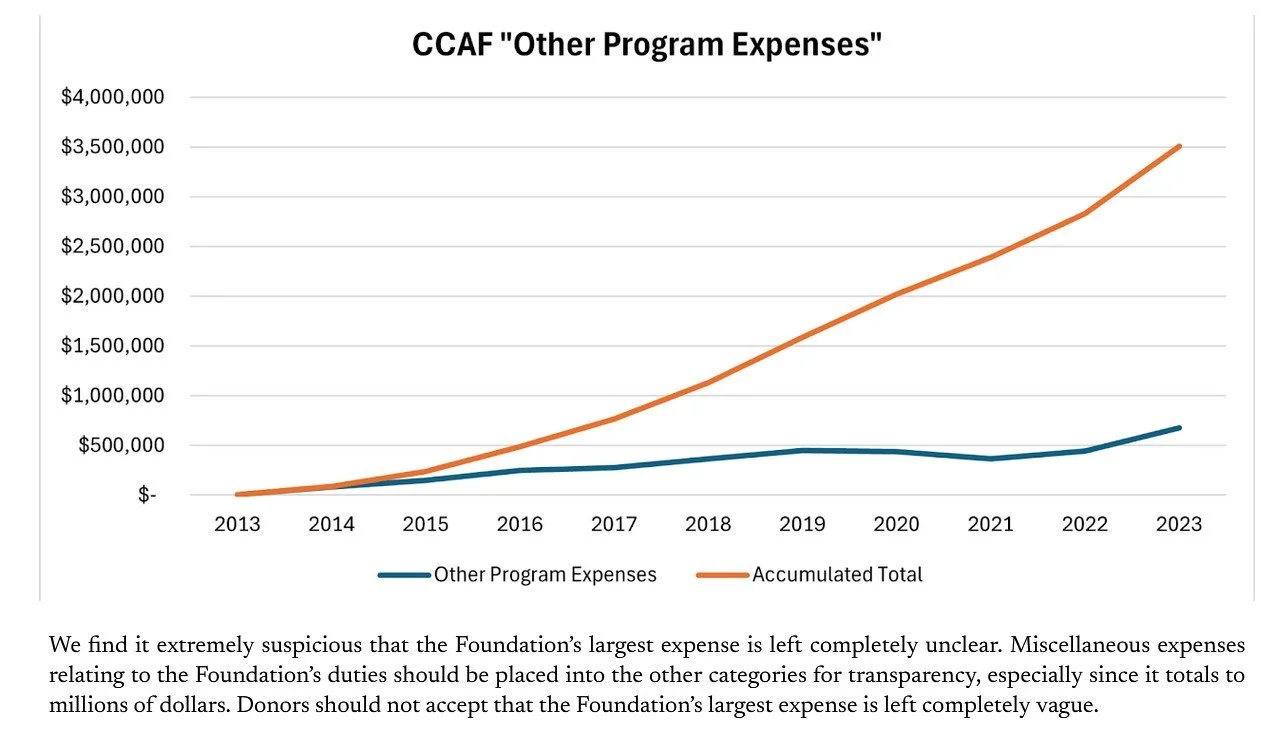
Up and Away: A graph from the students' report on the Foundation shows the ballooning of the amorphous "other" expense category over time.

Instead, schools who are the subject of critical reporting behave like most other corporations out there, and in fact they tend to be among the more shameless of corporate actors in their single-minded focus on only their own interests. So, instead of upholding values like transparency, or good faith debate about matters of public concerns, or, whatever other First Amendment-related ideal, they instantly circle the wagons, and blame the messenger. They do that even when doing so involves trashing the reputation of their own students.

In this case, the principal of Canyon Crest Academy has “condemned the report and reprimanded its authors,” according to the Union-Tribune, never mind that the report seems to have identified serious questions about the Foundation’s former leadership and accounting to the tune of several hundred thousand dollars. It is unclear if any formal discipline will be imposed, but the general approach of attacking the students’ reputation in the media is already, I would say, an adverse impact.

The principal is quoted as saying that “while the school board acknowledges the First Amendment’s freedom of speech protection, the board ‘also expects that all speech and expression will reflect norms of civil behavior on district grounds.’ ”

But the students are not on “district grounds”: their report is on an independent website. So what standards apply here?

In a way, this report is merely one example of a phenomenon that comes up frequently now in connection with social media, which is Internet posting by students about content that is school-related but which is not hosted on school servers or presented via school media. A very different variation on the same theme are the recent reports about deepfake pornography created by male students targeting female students, though that example does not involve the significant public accountability thread that is present in the Canyon Crest scenario.

Student speech rights are not as broad as those of adults, and can be regulated in certain ways (for example, speech advocating drug use is subject to limitation under the famous “Bong Hits 4 Jesus” case, Morse v. Frederick). When it comes to off-campus speech of the sort that is going on in the Canyon Crest case, the relevant question is whether the speech “ ‘might reasonably lead school authorities to forecast substantial disruption of or material interference with school activities.’ ” Wynar v. Douglas County Sch. Dist., 728 F.3d 1062, 1067, quoting Tinker v. Des Moines, 393 U.S. 503, 514 (1969). Such “substantial disruption” might be expected, for example, in the deepfake example or in instances of expressing racist or otherwise deeply offensive points of view about students or faculty. See, e.g., Chen v. Albany Unified Sch. Dist., 56 F.4th 708 (9th Cir. 2022).

On the flipside, a student’s mere use of social media to express a pointed general sentiment, such as “Fuck school fuck softball fuck cheer fuck everything,” does not give the school the power to imposed discipline, since that sentiment, even if it expresses “negativity,” is very unlikely to cause a “substantial disruption” or to interfere with anybody in particular. Mahanoy Area Sch. Dist. v. B.L., 594 U.S. 180 (2021). Here, the report on the foundation strikes me as being much more like saying “fuck cheer” (or perhaps “fuck the way this foundation is being run”) than any sort of potentially disruptive or improperly personalized content. In fact, if anything, the authors of the report seem to be performing the valuable function of standing up for integrity and transparency, not actually trying to disrupt anything at all.

And Thank Goodness: High school students do, in fact, have the First Amendment right to say "fuck cheer fuck everything."

Which means that, at least in theory, the school should probably not be trying to shut down the authors, and the perceived “civility” of the report, or lack thereof, does not change that fact. (By the way: does it uphold “civility” for adults to trash student journalists in the media?) In any event, surprisingly often it’s the case that schools, despite the role they potentially could play in setting an example around the importance of public debate, lash out first in response to critical speech, and only sort out the legality of their own actions after the fact.

For free consultation about potential civil rights cases, call today.

LAPD Finds No Wrongdoing by Sergeant Who Shared Offensive George Floyd Meme

An LAPD sergeant who shared an offensive meme about George Floyd has been cleared of wrongdoing by the department. The meme, sent on Valentine’s Day, featured an image of Floyd and the caption “You take my breath away.”

As outrageous as the content of that meme is, there do seem to be ambiguities in this case about the intent of the sergeant. His attorney is quoted by the LA Daily News as saying “The officer found the meme offensive, he did not create the meme, nor did he distribute it beyond notifying a commanding officer of its existence.” Tough to know if that is accurate, but at the same time there may be a value (in the context of our contemporary culture) in not taking everything in the worst possible light.